
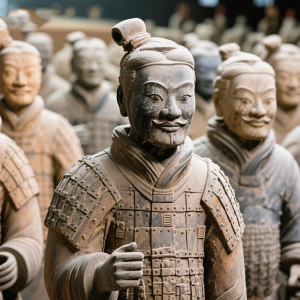
An Army That Waited Two Thousand Years
There are few moments in China that stop you as completely as your first sight of the Terracotta Army. You walk to the edge of a vast, roofed pit, look down, and find yourself facing row upon row of soldiers who have kept watch in silence for more than two millennia. They are not replicas. They are not a film set. They are the real thing — an army of baked clay, made to guard an emperor in the afterlife, and utterly forgotten until a farmer’s shovel found them in 1974.
For the mature traveler, this is a place that rewards patience. Rushed, it is a crowded hall of figures. Given time, it becomes something far more intimate: a window into the mind of an empire, and into the hands of the ordinary craftsmen who built it.
The Discovery
In March 1974, a farmer named Yang Zhifa was digging a well near the village of Xiyang, in Lintong county about 40 kilometres east of Xi’an. His shovel struck something hard — a fragment of pottery, then another, then the unmistakable torso of a clay soldier. Word reached archaeologists, and what they uncovered changed our understanding of imperial China forever.
The army belonged to Qin Shi Huang, the first emperor of China, who unified the country in 221 BC and began work on his mausoleum soon after ascending the throne. The historian Sima Qian wrote that the tomb was filled with treasures and guarded by figures of soldiers. For centuries, almost no one believed it. The discovery proved the old historian right.
The Three Pits
The museum covers three main excavated pits, and understanding them makes the visit far richer:
- Pit One — the main army. The largest and most famous, holding an estimated 6,000 infantry soldiers in battle formation, with war horses and chariots. Only part of it has been excavated. This is the iconic view, and the one that takes your breath away.
- Pit Two — the mixed force. A more complex formation of archers, cavalry, chariots and infantry — the army’s tactical variety. It was never fully completed, which is why the figures here are less densely packed.
- Pit Three — the command post. The smallest, holding officers and a war chariot. Archaeologists believe this was the headquarters of the whole formation. Its relative emptiness is strangely moving: the generals, alone, directing an army that never marched.
Faces That Are Never the Same
The detail is what holds you. The soldiers stand around 1.8 metres tall, officers taller, each with a face that is individual — different moustaches, different expressions, different ways of wearing the hair. Some look stern, some almost weary, some surprisingly young. Legend says each was modelled on a real soldier from the emperor’s army.
They were made in workshops by hundreds of craftsmen, assembled from separately fired parts — legs, torso, arms, head — then finished with painted details and real weapons in hand. The colours have mostly faded on exposure to air, which is why conservators now work carefully to stabilise what remains. What survives is enough: the sense that these were made by people who knew the men they were portraying.
Bronze, Not Just Clay
Two extraordinary bronze chariots were unearthed nearby in 1980, each pulled by four horses and driven by a standing charioteer. They are about half life-size, cast in astonishing detail, and are among the finest pieces of ancient Chinese metalwork ever found. Look for them in a separate hall — they are easy to miss if you only visit the pits.
The original weapons — bronze swords, spears and crossbow triggers — are displayed in the museum’s collection. Many emerged from the earth still bright and sharp after two thousand years, a testament to the sophistication of Qin metallurgy. Standing before a sword that was made before the Roman Empire, it is hard not to feel the reach of this civilization.
Visiting Well — A Practical Note
The museum lies about 40 kilometres from central Xi’an and is an easy day trip. A few things make the difference between an exhausting visit and a memorable one:
- Go early. The site opens in the morning and fills quickly, especially in peak season and Chinese holidays. An early arrival gives you the pits almost to yourself for the first hour.
- Hire an official guide, or join a small group. The stories behind the figures — how they were made, what the formations meant, what the excavation was like — transform the visit from “impressive” to “unforgettable.” Audio guides are available in several languages.
- Save your steps. The pits are large and the site spreads out. Electric shuttles run between the main areas; use them. There are places to sit and rest, and a gentle pace is the wisest one.
- Allow two to three hours. Most tour groups allow forty minutes. Give yourself longer and you will see details most visitors walk straight past.
- Wear comfortable shoes and bring water. Much of the visit is on level paths, but there is a fair amount of walking between halls.
If your heart is set on the full imperial story, the mausoleum of Qin Shi Huang itself lies a short distance away, with a park and a viewing mound. It is quieter than the museum and worth the extra journey if history is your reason for travelling.
A Piece of the Empire to Bring Home
Many visitors leave wanting something that captures the place — not a photograph, which everyone has, but an object with weight and meaning. Small replicas of the terracotta guardians, carefully made in clay rather than plastic, carry something of the original: the patience of the craftsman, the scale of the ambition, and the memory of a morning spent looking into the eyes of an ancient army.
Like the soldiers themselves, the best souvenirs here are the ones that reward a closer look. Choose slowly. You will be taking home more than a reminder of a place — you will be carrying a small piece of a story that waited two thousand years to be told. Explore our handcrafted collection to find a piece that speaks to you.